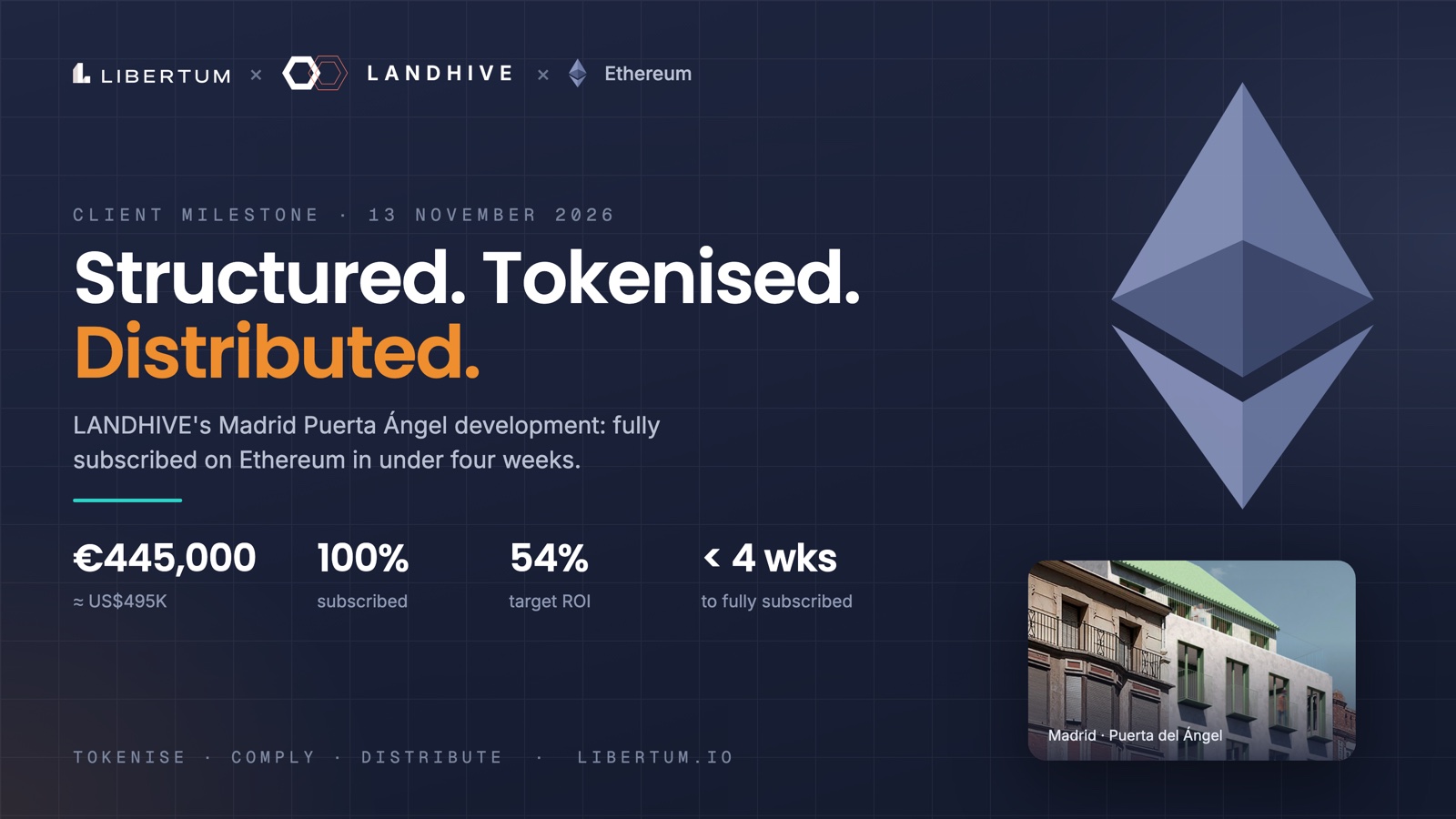
On 20 October 2026, LandHive listed Madrid Puerta Ángel, a residential development in Madrid, on its investor portal. On 12 November, the offering was 100% subscribed and all 100 tokens had been minted on Ethereum mainnet. That is under four weeks from listing to a fully funded, fully on-chain offering.
This post walks through how it was done, step by step, for developers and issuers who want to do the same. The press release has the headline facts.
The brief
The asset is a residential development at C/ Andújar 4, in Madrid’s Puerta del Ángel neighbourhood, close to Madrid Río. The project replaces an older building with new apartments.
LandHive wanted to raise €445,000 (about US$495,000) for it from eligible investors, with every holder verified, every transfer checked, and a public record anyone could inspect. And it wanted to do it on its own portal, portal.landhive.io, which already runs on Libertum’s white-label T-Suite.
Step 1: Structuring
Before any code, the terms. LandHive set them with Libertum’s support:
- Size and units: €445,000 split into 100 tokens at €4,450 each.
- Minimum investment: €50,000.
- Eligibility: who can invest, and which identity checks they must pass first.
- Lock-up: how long holders commit before they can exit.
- Target: LandHive’s stated target is a 54% projected ROI over the development. It is the issuer’s target, not a guarantee.
These decisions become rules. Eligibility turns into identity requirements; the token count becomes the supply; transfer restrictions become compliance settings. Getting them right first is what makes the next steps fast.
Step 2: Tokenisation on Ethereum with ERC-3643
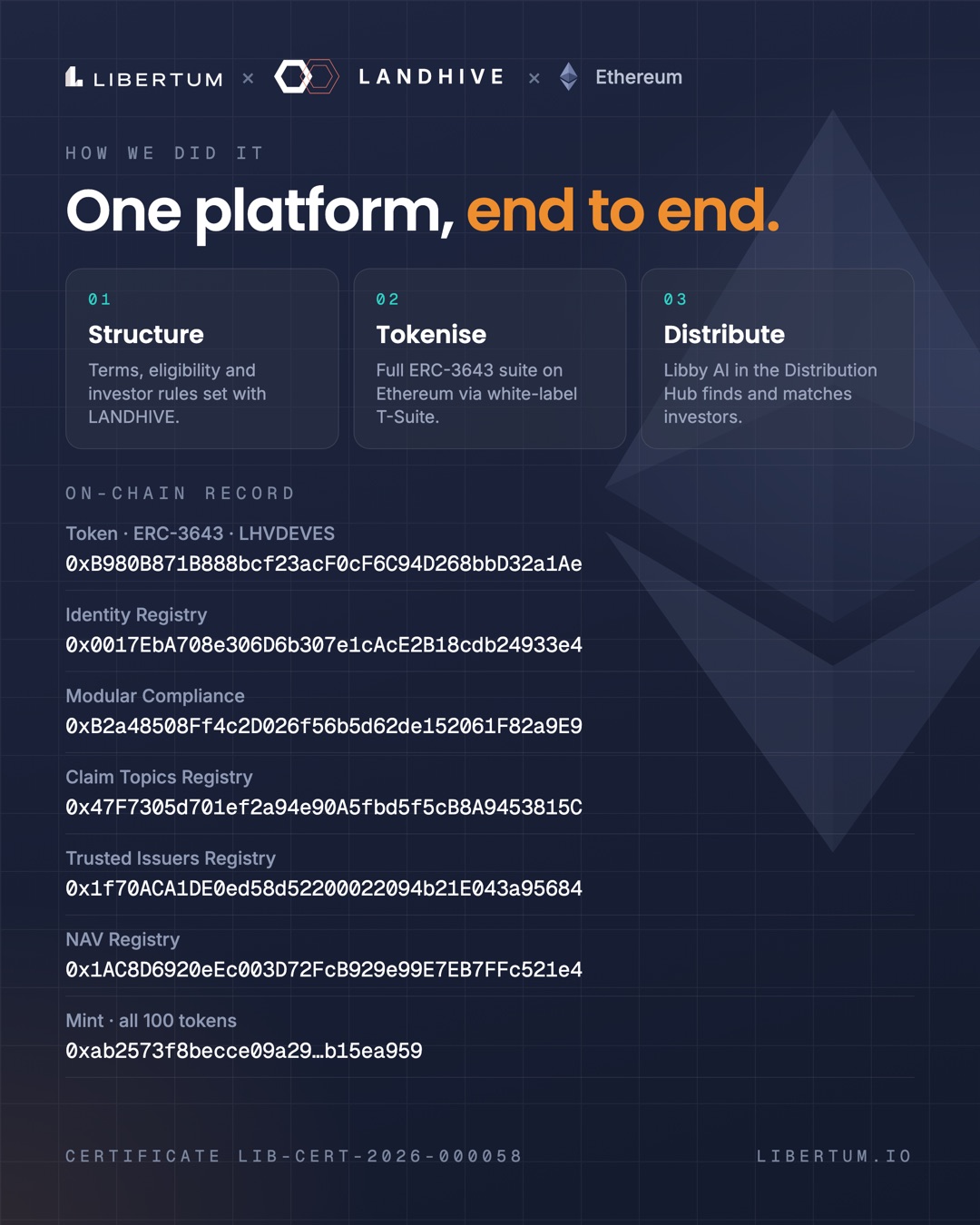
The offering was issued as LHVDEVES, an ERC-3643 token (T-REX 4.0.0) on Ethereum mainnet. ERC-3643 is a permissioned security-token standard: a token can only be held by verified identities, and every transfer is checked before it happens. It is not one contract but a small suite that works together. In plain English:
- The token is the security itself: 100 units, each representing a share in the offering. Unlike an ordinary token, it asks the other contracts for permission before it moves.
- The identity registry links each holder’s wallet to an on-chain identity (an ONCHAINID). If a wallet is not in the registry, it cannot receive the token. Its storage contract keeps those records.
- Claim topics define what must be proven about a holder, for example that they passed KYC.
- Trusted issuers define who is allowed to vouch for those claims. Together, these two registries turn the offering’s eligibility rules into code.
- Modular compliance applies the offering’s transfer rules to every movement of the token, so a transfer that breaks the rules fails instead of settling.
- The NAV registry publishes the price per token on-chain, so the value of a holding is a public record rather than a figure in a spreadsheet.
T-Suite deployed all of this in a single transaction through the T-REX factory and gateway, so the suite came into existence together, already wired up. You can see that deployment transaction on Etherscan. Libertum then issued a smart-contract certificate for the suite, LIB-CERT-2026-000058, which anyone can verify.
Step 3: Distribution with Distribution Hub and Libby
A compliant token still needs the right investors. This is where the Distribution Hub came in: an investor CRM inside T-Suite where an issuer’s team manages contacts, organisations and its pipeline.
With Libby AI, Libertum’s AI investor-research assistant, the Hub does more of the groundwork:
- Finds investors on the public web, such as firm websites, regulator registers and filings, and reputable press, with a source for every item so it can be checked.
- Enriches each record with what matters: investor type, ticket size, the countries they invest in and key people.
- Matches them against the offering’s criteria (asset class, ticket size, jurisdiction and investor type) and explains why each one fits.
- Feeds a CRM pipeline the issuer’s team works through.
Libby prepares; people decide. Nothing is sent automatically: LandHive’s team ran the outreach and the conversations. And before anyone can hold the token, they verify their identity (KYC) in the portal, which is what puts them in the identity registry.
Step 4: Settlement and mint
Once payment had been received and confirmed, the tokens were minted to verified wallets. The mint of all 100 tokens took place on 12 November 2026, the same day the NAV of €4,450 per token was published on-chain. The token page on Etherscan shows a total supply of 100.
The results
- 100% subscribed in under four weeks: listed 20 October, fully minted 12 November 2026.
- €445,000 (≈ US$495,152) raised through 100 tokens.
- One stack from terms to mint: structuring, issuance, KYC, compliance, distribution and settlement on white-label T-Suite.
- A public, verifiable record: every contract, the deployment and the mint are on Ethereum mainnet, and the certificate can be checked by anyone.
What the collaboration shows
Libertum and LandHive have been one group since their share swap. Madrid Puerta Ángel is the first offering to show what that means in practice. LandHive brought the development, the investor relationships and more than two decades of experience of how real estate is financed and delivered. Libertum brought the technology and the compliance. With one group and one stack, there were no hand-offs between vendors, no rebuilding of investor data between tools, and one team working from structuring through to mint, within the scope of each group company’s licences and authorisations.
For other developers, the point is simple: the same infrastructure is available to them, under their own brand.
Real estate ownership, opened up
Real estate is a tangible asset that has historically held its value through market cycles, and for most people ownership of a development like this has been out of reach. Tokenisation changes the mechanics: clear terms, verified holders, transparent on-chain records and a price published for everyone to see. It lets more eligible investors take part in real, tangible projects, with the rules built in rather than bolted on.
It doesn’t remove the risks. Development projects can be delayed, costs can change and values can fall as well as rise. Investors should read each offering’s documents and consider whether it suits them.
Bring your next offering to market
If you’re a developer, issuer or asset manager, you can run the same playbook under your own brand:
- White-label T-Suite: your own branded portal for issuance, onboarding and compliance.
- Distribution Hub and Libby AI: build and work your investor pipeline.
- LandHive case study: the full picture, with sources.
Get in touch to talk about your asset.
Libertum, S.A. de C.V.’s CNAD registration (PSAD-0094) applies in El Salvador and covers the activities in its registration only; it does not authorise activities in other jurisdictions. Each group company operates within the authorisations it holds. This article does not constitute an offer of any security or digital asset. Targets are estimates, not guarantees; capital is at risk.