LONDON and SAN SALVADOR, 22 October 2026
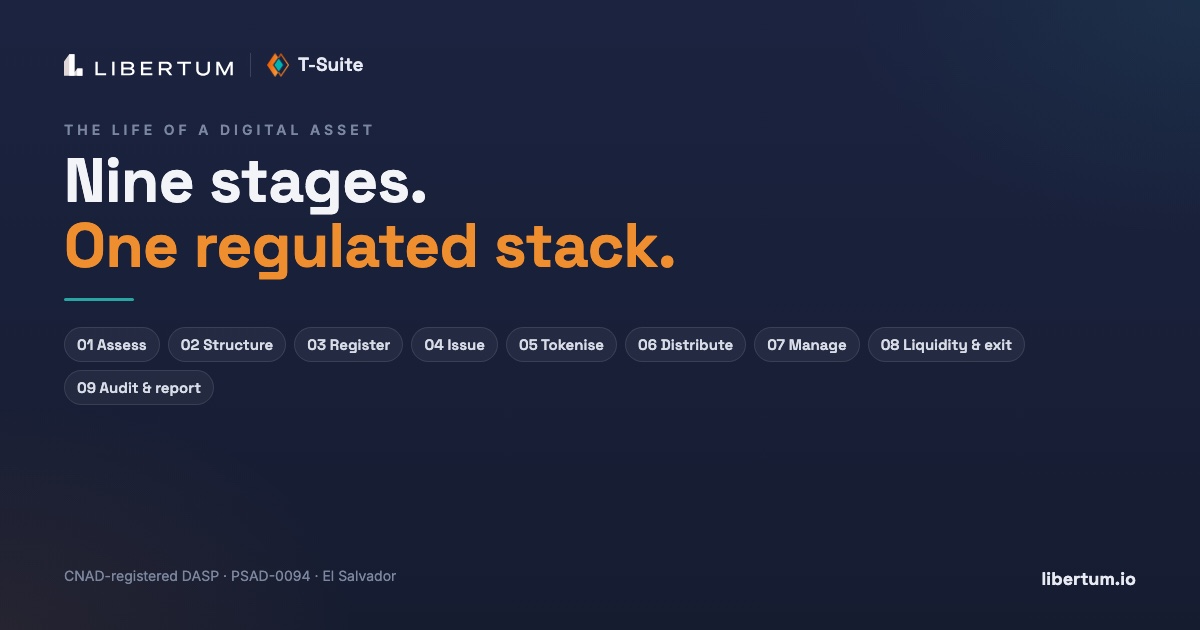
Libertum, the real-world asset tokenisation company behind the T-Suite platform, today published The Life of a Digital Asset. It is a nine-stage framework that sets out what an asset goes through on its way on-chain and for the rest of its life, and where Libertum supports issuers, funds and their investors at each stage.
The nine stages are assessment, structuring, registration, issuance, tokenisation, distribution, lifecycle management, liquidity and exit, and audit and reporting. An issuer today typically works through them with a different provider for each: legal advisers, a token vendor, a custodian, a CRM and a registrar. The framework shows how Libertum brings them together in one stack with two layers:
- Libertum, the regulated layer. Libertum, S.A. de C.V. is registered with El Salvador’s Comisión Nacional de Activos Digitales (CNAD) as a Digital Asset Service Provider under registry entry PSAD-0094. Its authorised scope is Article 19 (a), (d) and (f) 1–2 of the Ley de Emisión de Activos Digitales, which includes the custody of digital assets. It operates the custodian wallets that hold investors’ tokens and stablecoins, maintains Libertum’s compliance policies, and reports to the CNAD as a supervised entity.
- T-Suite, the workflow layer. T-Suite is the tokenisation platform issuers use across all nine stages, under their own brand and on their own domain.
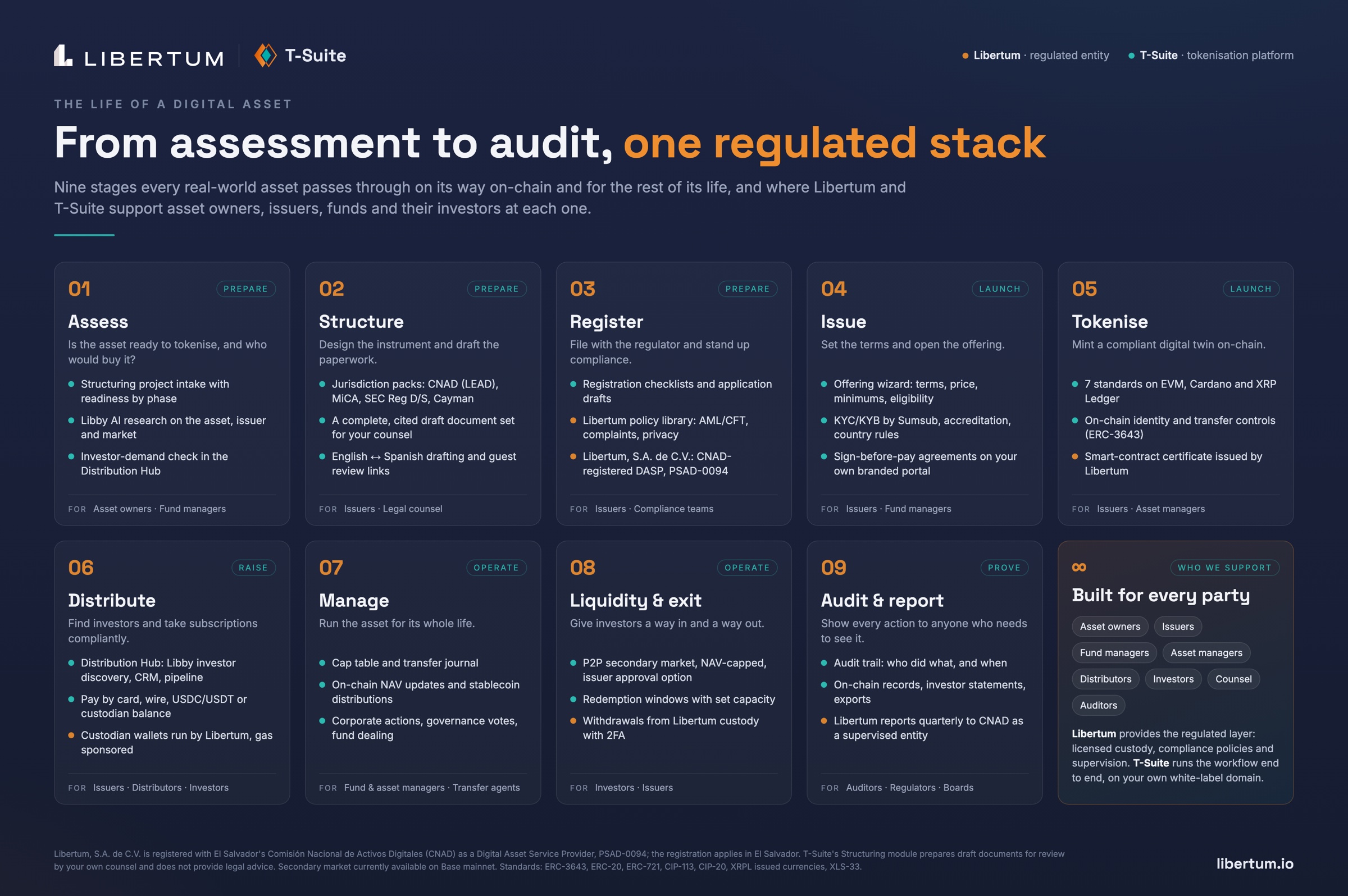
How T-Suite and Libertum support each stage
- Assess: Structuring projects score an issuance’s readiness phase by phase. Libby, T-Suite’s AI analyst, researches the asset, the issuer and the investor market.
- Structure: jurisdiction knowledge packs for El Salvador (CNAD/LEAD), the European Union (MiCA), the United States (SEC Reg D/Reg S) and the Cayman Islands guide issuers through what each framework requires, and draft a complete, cited document set for review by their own counsel.
- Register: registration checklists and application drafts, alongside Libertum’s library of compliance policies.
- Issue: an offering wizard covers terms, pricing, minimums and investor eligibility. Identity checks (KYC and KYB by Sumsub), accreditation, country rules and sign-before-pay agreements come built in.
- Tokenise: seven token standards across EVM networks, Cardano and the XRP Ledger, including ERC-3643 with on-chain identity and transfer controls. Every deployed contract receives a smart-contract certificate issued by Libertum.
- Distribute: the Distribution Hub uses Libby to find and research investors and runs the pipeline and outreach. Investors can pay by card, bank transfer, USDC/USDT or their custodian balance, with network fees sponsored.
- Manage: cap table and transfer journal, on-chain NAV updates, stablecoin distributions, corporate actions, governance votes and fund dealing.
- Liquidity and exit: a peer-to-peer secondary market capped at the current NAV and live on Base mainnet, redemption windows, and withdrawals from Libertum custody protected by two-factor authentication.
- Audit and report: an audit trail of every action, on-chain records, investor statements and data exports.
The full stage-by-stage walkthrough is on the Libertum blog: The Life of a Digital Asset.
About Libertum
Libertum builds infrastructure for the tokenisation of real-world assets. Its T-Suite platform lets issuers, asset managers and funds structure, issue, distribute and manage tokenised assets under their own brand, on EVM networks, Cardano and the XRP Ledger. Libertum, S.A. de C.V. is registered with El Salvador’s CNAD as a Digital Asset Service Provider (PSAD-0094). Libertum LLC is registered with the US Financial Crimes Enforcement Network as a Money Services Business (31000312444528).
Media contact
Libertum: [email protected]
Libertum, S.A. de C.V.’s CNAD registration applies in El Salvador and does not authorise activities in other jurisdictions. Issuers remain responsible for their own authorisations. T-Suite’s Structuring module prepares draft documents for review by the issuer’s own counsel and does not provide legal advice. FinCEN registration is a compliance obligation, not an endorsement. This release does not constitute an offer of any security or digital asset.